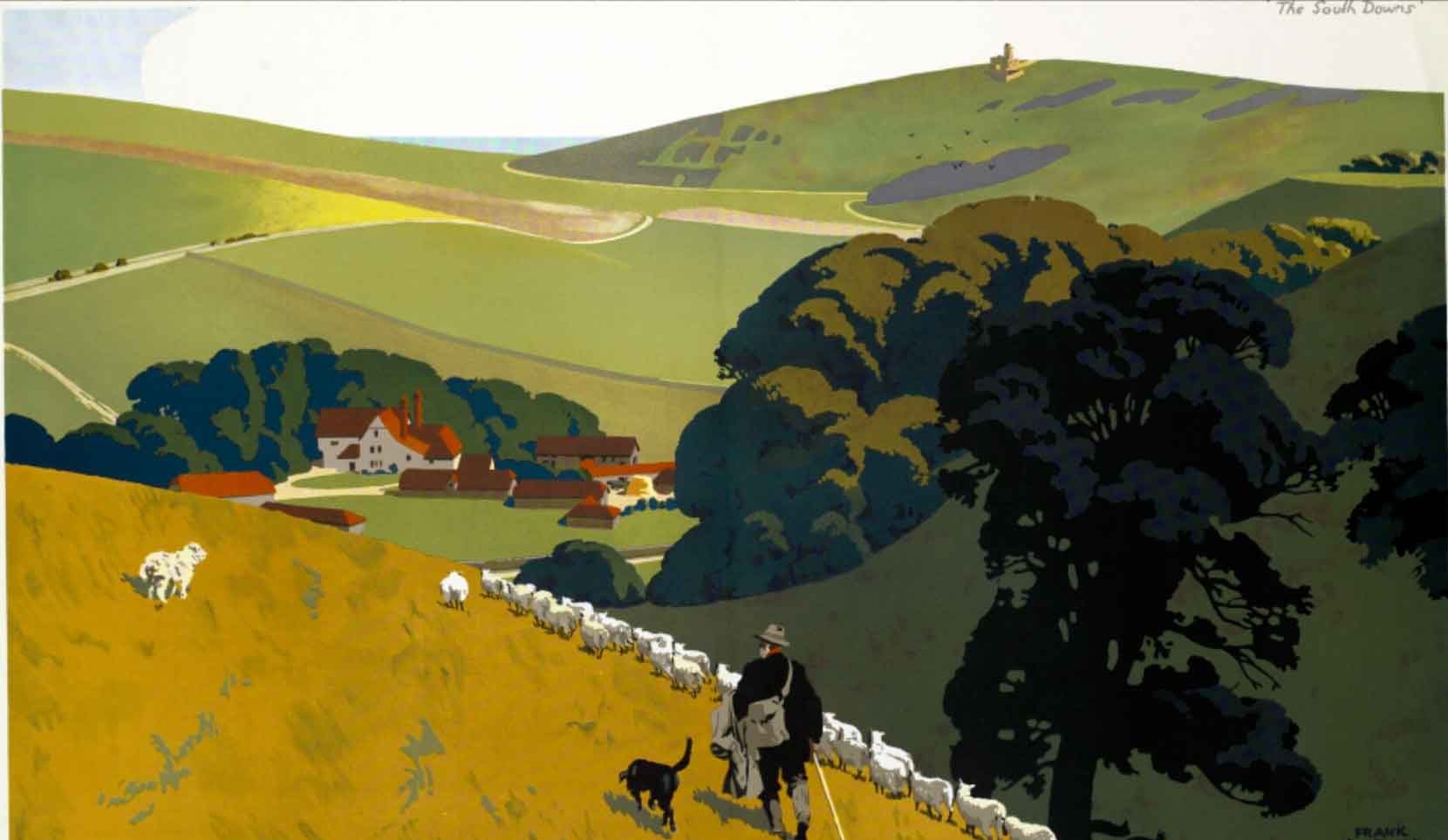
This post is by Guy Shrubsole. Image: Frank Newbould, ‘The South Downs: Your Britain – Fight for it Now’, 1942. Updated 11th May 2025 with more details on Friston Forest.
Just 29 landowners own over 100,000 acres of the South Downs, stretching 100km along the chalk outcrop, Who Owns England can reveal.
Back in 2018 I had a first crack at mapping major landowners in the South Downs National Park. Now I’ve made a much more comprehensive map of who owns the chalk downland itself.
My Google Map below shows who owns the South Downs, stretching from the Queen Elizabeth Country Park in the west to Beachy Head in the east. Click on each land parcel to bring up the owner details:
The map was assembled using Highways Act s31 landowner deposits; maps of Environmental Stewardship payments; reference to LandExplorer; Index INSPIRE polygons; and Land Registry data.
Here’s a static version of the same map, with labels:
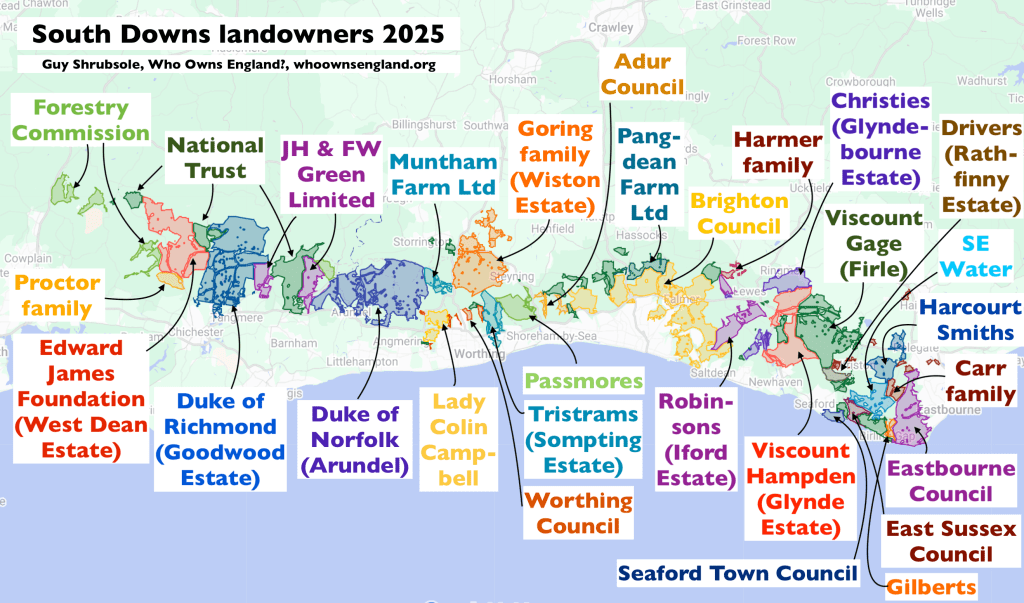
And here’s a table listing the owners, estates, acreage and some notes on each one:
| Estate | Landowner | Area (acres) | Type of landowner | Notes |
| Brighton Downland Estate | Brighton Council | 11,780 | Council | Acquired in early 1900s to protect from development and to secure water supply for Brighton. |
| Arundel & Angmering Estates | Duke of Norfolk | 10,910 | Aristocracy | Arundel Castle & Estate is the seat of the Duke of Norfolk; the neighbouring Angmering Estate is owned by heirs and other members of the Norfolk family |
| NT land in South Downs | National Trust | 10,538 | NGO | The National Trust began acquiring land in the South Downs from the 1920s onwards, such as Cissbury Ring. Other properties include the Slindon Estate, Harting Down, Devil’s Dyke, Ditchling Beacon and Blackcap. On the coast, the Trust purchased Birling Gap, part of an interwar campaign to preserve the area from development which also involved several local authorities purchasing land (see other entries). |
| Goodwood Estate | Duke of Richmond | 10,370 | Aristocracy | Seat of the dukes of Richmond since 1697. |
| Firle Estate | Viscount Gage | 7,151 | Aristocracy | Gage family have owned the estate since the 15th century. |
| West Dean Estate | The Edward James Foundation Limited | 6,322 | Charity | Bequest of surrealist painter Edward James, now run by foundation. |
| Wiston Estate | Goring family | 6,175 | Landed gentry | Ancestor planted beech clump at Chanctonbury Ring. |
| Glynde Estate | Viscount Hampden | 4,714 | Aristocracy | Glynde Place was built in 1589 by ancestors of the current owners. |
| Eastbourne Downland Estate | Eastbourne Council | 4,085 | Council | Acquired 1920s to protect from development |
| FC land in South Downs | Forestry Commission | 3,391 | Government | Main FC freehold properties located in the west of the South Downs. |
| Dale Park Estate & Selhurst Park Estate | J.H. & F.W.Green Limited | 2,962 | Farmer | Details of the farming company on Companies House. |
| Glyndebourne Estate | Christie family | 2,689 | Landed gentry | Famous for its opera house since the 1930s. |
| Iford Estate | Robinson family | 2,671 | Landed gentry | Founded 1895. Website says Iford Estate is 3,000 acres so map may be missing some areas. Iford were one of the first Biodiversity Net Gain (BNG) pilots and have been restoring some areas of chalk downland. |
| Friston Forest | South East Water | 2,068 | Company | Acquired as a catchment area for waterworks; leased to the Forestry Commission in 1926 who afforested it (see comments section below) |
| Wootton Manor Estate | Sabrina Harcourt-Smith | 1,871 | Landed gentry | Owns the downland around the Long Man of Wilmington (the chalk figure itself is owned by the Sussex Archaeological Society) |
| Coombes Farm | Passmore family | 1,830 | Farmer | Passmore family have owned and farmed here since 1901. |
| Sompting Estate | Tristram family | 1,808 | Farmer | Owned by the Tristrams for 250 years. |
| Jevington Place Farm | S & F Carr & Daughters & the Premier Trust SJ Carr | 1,435 | Farmer | Stephen Carr writes the ‘Agri Brigade’ column for Private Eye. Link states his farm is 800ha (1,900 acres) so map may be missing some of it. |
| Castle Goring Estate | Lady Colin Campbell | 1,163 | Aristocracy | British-Jamaican author and socialite; more info. |
| Pangdean Farm | Pangdean Farm Ltd | 1,160 | Offshore company | Pangdean Farm Ltd is registered in Jersey; see Companies House. |
| Muntham Farm | Heath family (Muntham Farm Ltd) | 929 | Farmer | Farming company on Companies House. |
| Langford Farm | Proctor family | 765 | Farmer | RA Proctor is recipient of environmental stewardship payments for the farm. See also here. |
| Seven Sisters | East Sussex County Council | 739 | Council | Acquired in 1920s to protect from development |
| Adur District Council Downland Estate | Adur District Council | 645 | Council | Unknown when acquired, but likely in 1920s-30s to protect from development |
| Worthing Council Downland Estate | Worthing Council | 603 | Council | Acquired in 1930s to protect from development. More info. |
| Rathfinny Estate | Mark & Sarah Driver | 594 | Farmer | Vineyard, established 2010. |
| Seaford Head Nature Reserve | Seaford Town Council | 541 | Council | Acquired in 1920s to protect from development |
| Mill Lane Farm, Offham (Offham Farm?) | Harmer family | 423 | Farmer | Harmer family, have farmed at Offham for 240 years. Site of Offham Down SSSI ploughing in 1990s and subsequent ‘unploughing the downs’ protest. |
| Birling Manor Farm | Gilbert family | 344 | Farmer | Birling Manor farm is the farmhouse depicted in Frank Newbould’s famous wartime poster of the South Downs, ‘Your Britain – Fight For It Now’ – shown above. |
| TOTAL | 100,674 acres |


Another great blog! Can I suggest another interesting subject would be the top owners of riparian rights – who owns England’s rivers/riverbeds, along with who owns England’s Commons, such as Tyler’s Common in Upminster.
LikeLiked by 1 person
And of course, an update on housing developers land ownership!
LikeLiked by 1 person
Being a West Sussex resident all my life, very interesting read! Lets hope the ones purchased to protect redevelopment remain that way!
LikeLiked by 1 person
Great blog. Intriguing as always.
I’ve done some research into friston forest and have I think discovered why it is owned by a water company. In the early 20th century friston forest wasn’t a forest but instead a bare chalk Downland. Eastbourne water company ( later merged to form south east water )owned this land and the water would filter through the permeable chalk into a series of wells and tunnels constructed , which funnel the water to a pumping station. These wells are still visible today along with a sewage works presumably also operated by south east water , the pumping station building is still standing though I am unclear whether it is in operation. In 1926, the forestry commission were looking to expand the UK’s forests as a result of timber shortage , since Eastbourne water company worked entirely underground in friston forest they agreed the forestry commission to manage the land above and plant a forest. This lease agreement runs until 2126. So therefore , south east water owns the land but forestry commission manages it and is just another quirk of British land history.
https://www.flickr.com/photos/202806545@N06/54509230929/in/dateposted-public/
https://cdn.forestresearch.gov.uk/1951/04/fcfh083.pdf
LikeLiked by 1 person
This is really interesting and helpful – thanks!
LikeLiked by 1 person
A good if partial resource for land ownership in the South Downs National Park are the whole estate plans hosted on the SDNP website. They generally contain a map that shows the extent of the respective estates. https://www.southdowns.gov.uk/planning-policy/whole-estate-plans/endorsed-whole-estate-plans/
LikeLike